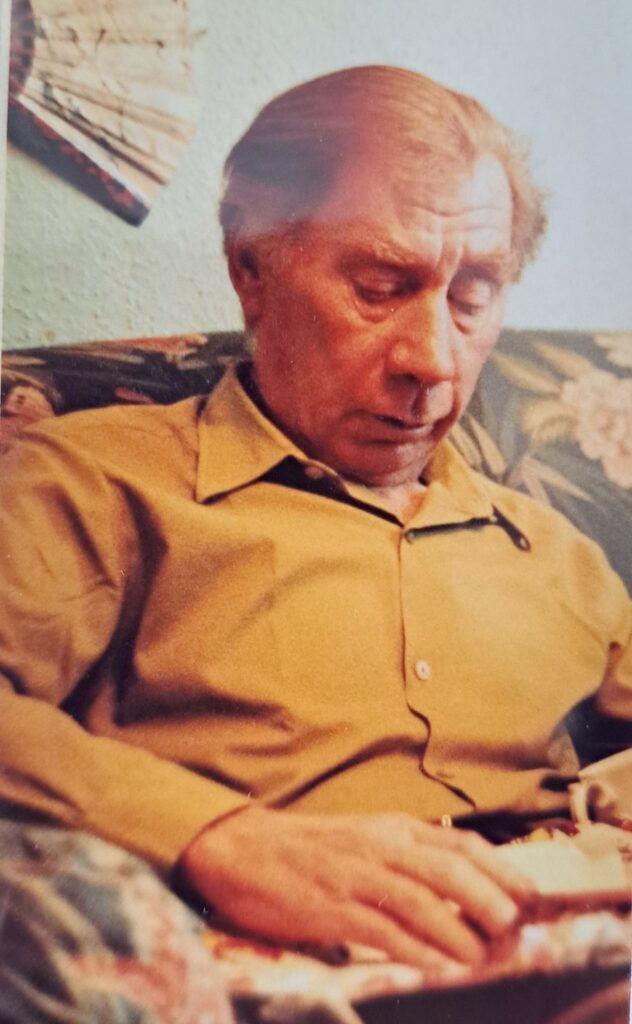
William Henry Young (1922-1990) started his working life at Christchurch College. Bill came to work at Hertford in 1937 as a boot boy, working with his future brother-in-law who was already at Hertford. He later became an under scout. He joined up in 1940 and returned to Hertford after the War in 1947, remaining there until 1960. Bill was a keen and accomplished sportsman and coached the University of Oxford Servants’ Rowing Club for many years.

Whilst cataloguing a collection of papers from our alumni organisation, the Hertford Society, last year, we found two audio cassettes recording the memories of someone who had been a college servant at Hertford from before the Second World War to 1960. The tapes turned out to have been recorded by Bill Young, who had worked at Hertford around about this period. We were lucky to be able to make contact with Bill’s son, Paul, who confirmed that it was his father speaking in the tapes. Many thanks to Paul for allowing us to use the tapes and for supplying us with photographs of his father. The discovery of these tapes is a great reminder that archives are not just made up of pieces of paper but of all sorts of media such as photographs, audio recordings, videos and now of course digital files. As the audio tapes are at a high risk of deteriorating and becoming unusable they have been digitised and we look forward to making the digital recordings more accessible to researchers and the general public.
What follows is taken from the memoirs that Bill recorded, and includes some clips from the original audio recordings. He describes a very different world from the Hertford College of today – one in which undergraduates were waited on to a degree that seems incomprehensible now. His pride in his work and the meticulous attention to detail, especially in his relationship with the Dining Club, comes over vividly; although he frequently mentions the wages which were very low considering the long hours and hard work. His huge enjoyment of the sporting activities of the College and especially of the University servants is evident throughout.
Boot Boys & Under Scouts
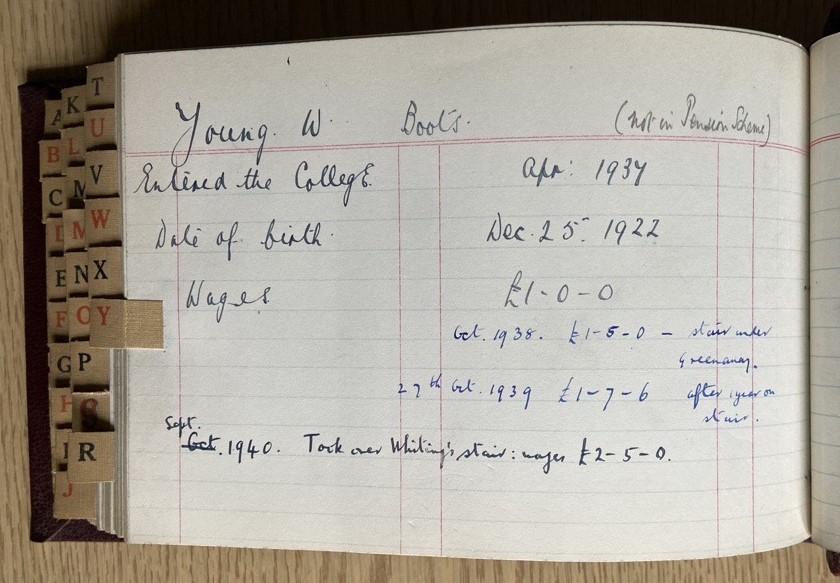
As Bill relates in his recording, the daily routine of boot boys and under scouts was very hard work, not least because of the primitive conditions of the college buildings before the Second World War. There were few bathrooms and very antiquated sanitary arrangements (the undergraduate toilets were in an outside block behind the current library building). There was no central heating which meant an enormous number of coal fires had to be kept going each day. Although breakfast and dinner were served in Hall, lunch was served in the students’ rooms. Accommodation was then, as now, arranged around staircases so domestic tasks were much more arduous than they needed to be.
As a boot boy, Bill’s first task before breakfast was to help collect all the shoes, polish and return them. After breakfast they cleaned the showers and bathrooms and then stoked the boilers to ensure there was a plentiful supply of hot water in the afternoon for the undergraduates when they came back from their sports. At the beginning of each term the boot boys were responsible for taking the undergraduates’ luggage to their rooms or to their digs if they were living outside the college. In the vacation they had to move the undergraduates’ possessions to their new rooms or to digs, using the college handcart.
Being promoted to an under scout did not lessen the work load and they worked a long day from 6am to 8pm. Before breakfast Bill would lay the coal fires in the rooms on his allocated staircase; and light fires for Armstrong and Boase, the two Fellows he was responsible for. He would then help serve breakfast in Hall and clean the undergraduate rooms. After that he would order the undergraduates’ lunches from the chefs and carry it to their rooms. If Armstrong and Boase were having lunch parties then three course lunches had to be taken to their rooms and served, cleared and washed up. Afternoon tea similarly had to be ordered and taken to rooms. A quick servants’ tea, then carry on filling coal boxes, collecting and washing up. Finally Bill would be ready to wait in Hall at 7pm to serve dinner, leaving college by 8pm if he was lucky.
Wartime & Later Years
Bill describes the run up to the outbreak of the Second World War in 1939. Hertford had already formed a fire brigade made up of staff and other college members. they were trained by Joe Humphries, the senior scout, in fire drill and later in putting out incendiaries. In 1940 Bill voluntarily enlisted with the Oxfordshire & Buckinghamshire Light Infantry. He remembers that Hertford had a policy of making up the service pay of men who were conscripted to the level of their college pay. Rather unfairly, this was not extended to Bill on the grounds that he had volunteered rather than being conscripted, and so he had to make do with his basic army pay. He served throughout the war in Northern Ireland and the Western Desert and came back to England in Sept 1946. Bill says that two former scouts did not return to Hertford as the pay was too low but he decided to return to the College. He describes the severe winter of 1947, with snow piled high, all traffic off the roads and walking everywhere through the biting cold.
Rowing & Sporting Activities
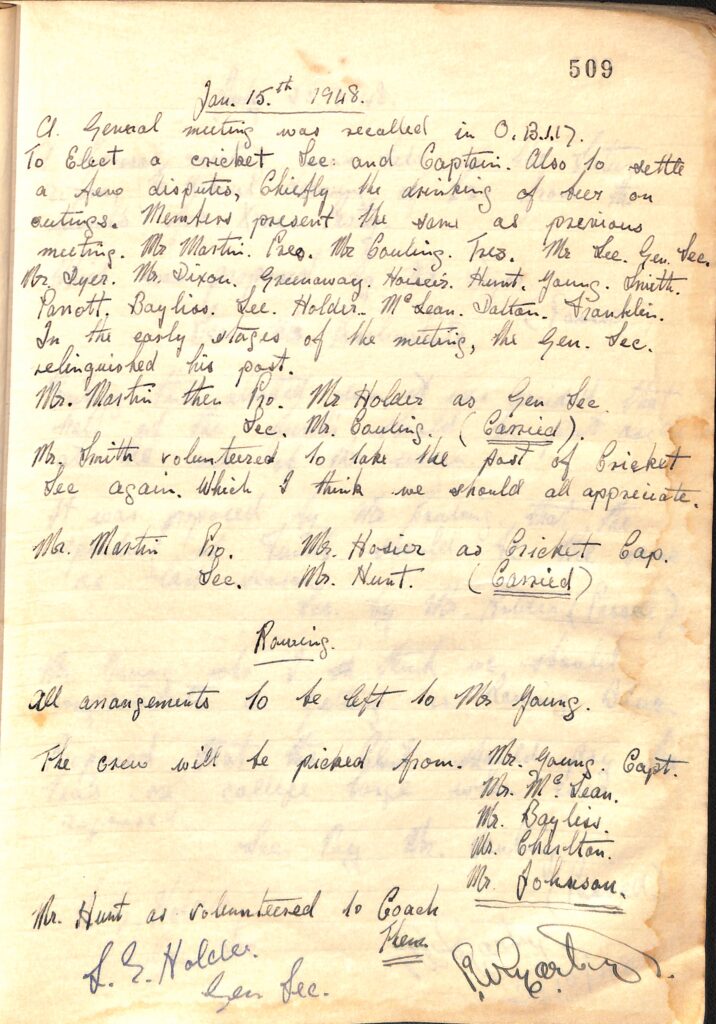
Bill was a passionate sportsman who was closely involved in the sporting life of the College – as these minutes of the College Servants Recreation Club record, as far as rowing was concerned ‘all arrangements to be left to Mr Young’.
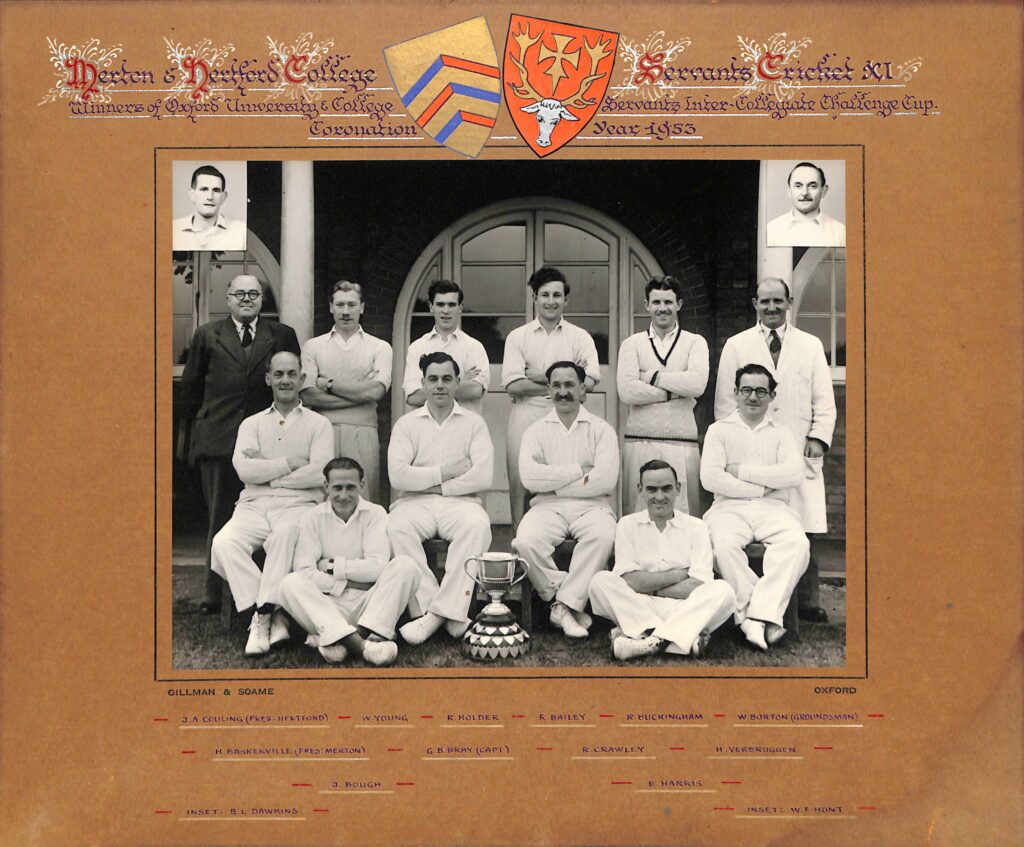
After Bill returned to Hertford he coached the Boat Club team, and in 1949 they got their first bump since 1939, moving them into the 2nd and then into the 1st division. He was also immensely proud of his activities with the college servants sports teams, in particular the University of Oxford Servants’ Rowing Club. The audio clip below records him talking about the undergraduates whom he remembered from before 1939 and the numerous servants’ sports teams which flourished during his time at Hertford – many of which were subsidised by contributions from Hertford undergraduates. Members of these clubs routinely won blues; Young himself had a blue for cricket, rowing and football.
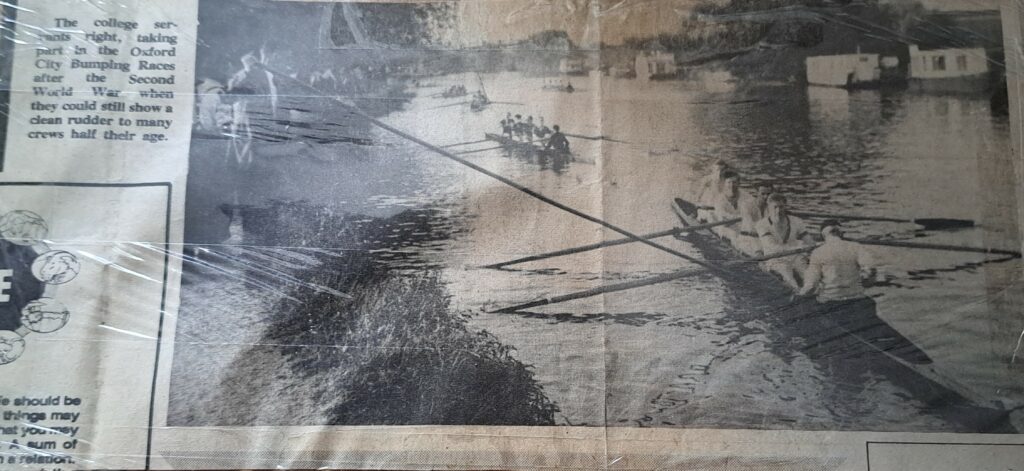
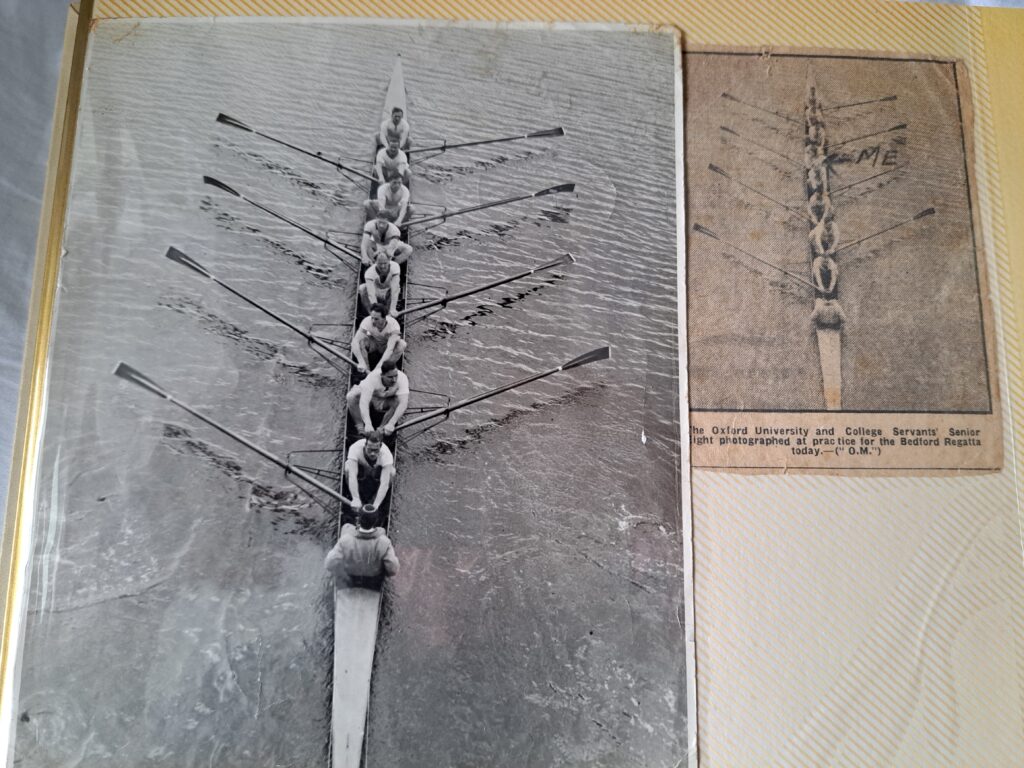
After the 1960s the servants’ sporting teams fell away, a matter of great sadness for Bill. He remained a traditionalist to the end and regretted the changing times which altered the character of so many Oxford colleges after the Second World War.
The undergraduates I knew at college were born gentlemen. I will never ever accept women in college. I cannot accept it and I cannot see how Hertford can be a ladies’ college as well as a gentlemen’s college.
William Henry Young
1922-1990